Gold ETF vs Silver ETF: What the Samvat 2083 Muhurat Trading Debate Means
Mint's Muhurat trading guide compares gold and silver ETFs after a sharp price run, citing projections of ₹1,80,000 gold and ₹3,00,000 silver by next Diwali. Our read: the choice hinges on volatility tolerance and ETF premiums, not just price targets.
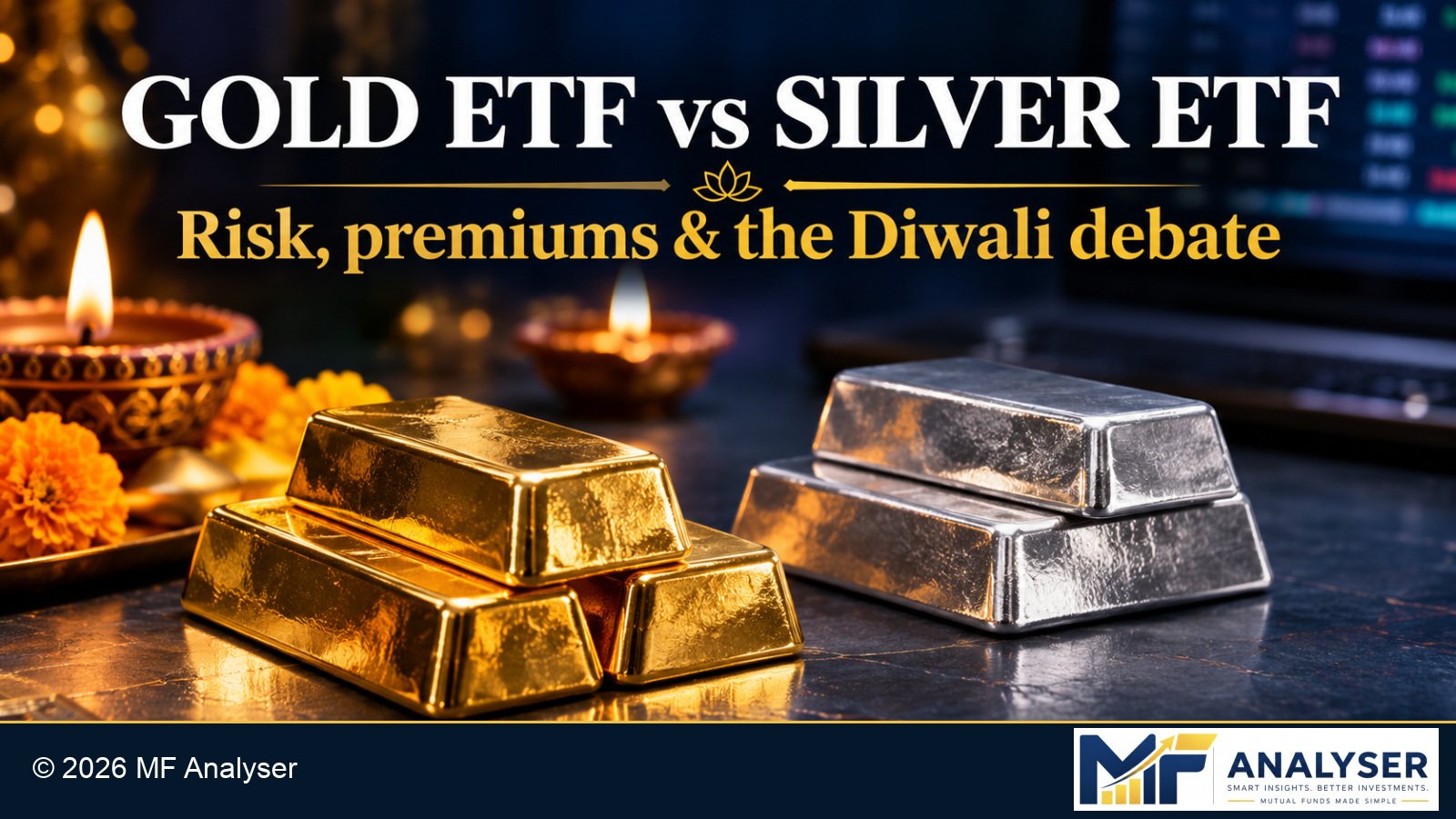
The gold-silver ETF debate is really about risk appetite and entry premium, not guaranteed higher returns.
- Gold and silver ETFs allow smaller investors to take metal exposure without buying physical metal outright.
- A SEBI-registered expert quoted by Mint projects gold to touch ₹ 1,80,000 and silver ₹ 3,00,000 by Diwali 2027.
- Silver ETFs can be more volatile than gold ETFs because silver has industrial as well as investment demand.
- ETF premiums and trade volume matter alongside price projections.
Mint’s pre-Diwali report on Muhurat trading 2026 compares gold and silver ETFs after their recent price surge, noting that these funds let smaller investors take metal exposure without buying physical gold or silver outright. The report quotes market experts projecting further gains, but also cautions that ETF premiums and an investor’s volatility tolerance matter more than price targets alone. (Source: Mint)
What happened
According to Mint, gold and silver ETFs trade on the BSE and NSE and can be bought directly with a demat account, or indirectly through a mutual fund route such as a fund of funds. The report says these products have drawn attention from marginal investors who cannot pay the full upfront cost of physical metal.
Anuj Gupta, a SEBI-registered market expert quoted by Mint, said gold is around ₹ 1,42,500 today and could touch ₹ 1,80,000 by the next Diwali, implying an expected rally of up to 26% during Samvat 2083. Silver, at around ₹ 1,85,000 per kg, could rise to ₹ 3,00,000 per kg by Diwali 2027, a projected rise of up to 62%. (Source: Mint)
Our analysis
The core distinction in the report is not which metal will rise more, but how each metal behaves. Pankaj Mathpal of Optima Money Managers told Mint that gold has investment value, while silver has both investment and industrial value. Central banks buy gold as a financial buffer, which can anchor demand, while silver’s industrial uses can add an extra layer of demand in good times and an extra source of pressure in bad times. That makes silver ETFs potentially more volatile than gold ETFs.
ETF pricing adds another layer. A gold or silver ETF can trade at a premium to the value of the metal it holds. If the premium is high, an investor is paying more than the underlying metal value, and that cushion can disappear if metal prices fall. The report suggests comparing the gap between the category return and a plan’s return as a way to spot expensive premiums, and warns that trade volume in these ETFs should also be checked.
Our read is that the expert projections are not a reason to choose one metal over the other. They are scenario paths. The same report quotes Mathpal saying a risk-averse investor may lean toward gold ETFs, while a high-risk investor may accept silver’s swings for the possibility of higher returns. That is a difference in risk capacity, not a guaranteed outcome.
What this could mean for you
- First-time precious metal ETF buyers may find ETFs a lower entry-cost way to track gold or silver prices, but the Mint report suggests watching the premium so they are not paying too far above the metal’s value.
- Risk-averse investors could experience smaller day-to-day swings in gold ETFs than in silver ETFs, because gold lacks silver’s industrial demand component, according to the experts quoted.
- High-risk investors considering silver ETFs may see both larger upside and larger downside if silver’s industrial demand shifts, so price movement can be sharper than gold’s.
- Investors without a demat account can still take exposure through a gold or silver ETF fund of funds, as the Mint report notes, though they would then hold a mutual fund unit rather than an exchange-traded unit.
What to watch next
- Watch whether ETF premiums remain low relative to their underlying metal value, as a high premium could narrow if metal prices fall.
- Track gold and silver price moves through Samvat 2083, since the expert quoted projects gold touching ₹ 1,80,000 and silver ₹ 3,00,000 by Diwali 2027. (Source: Mint)
- Watch for changes in industrial demand, which could make silver ETFs more volatile than gold ETFs.
Bottom line
The gold versus silver ETF question is less about which metal will deliver higher returns and more about an investor’s ability to tolerate volatility and the price they pay through ETF premiums. Mint’s Diwali guide suggests comparing both factors before drawing conclusions from headline projections.
Price projections mentioned above are third-party views reported by Mint. They are not MF Analyser's forecast or a recommendation; markets can move either way.
Source: Mint — Muhurat trading 2026 guide: Gold ETF vs Silver ETF on Diwali day — what to buy for higher returns in Samvat 2083?. This story was written by the MF Analyser News Desk with AI assistance and its figures were checked automatically against the original report. It is for education only and is not investment advice. Mutual fund investments are subject to market risks.