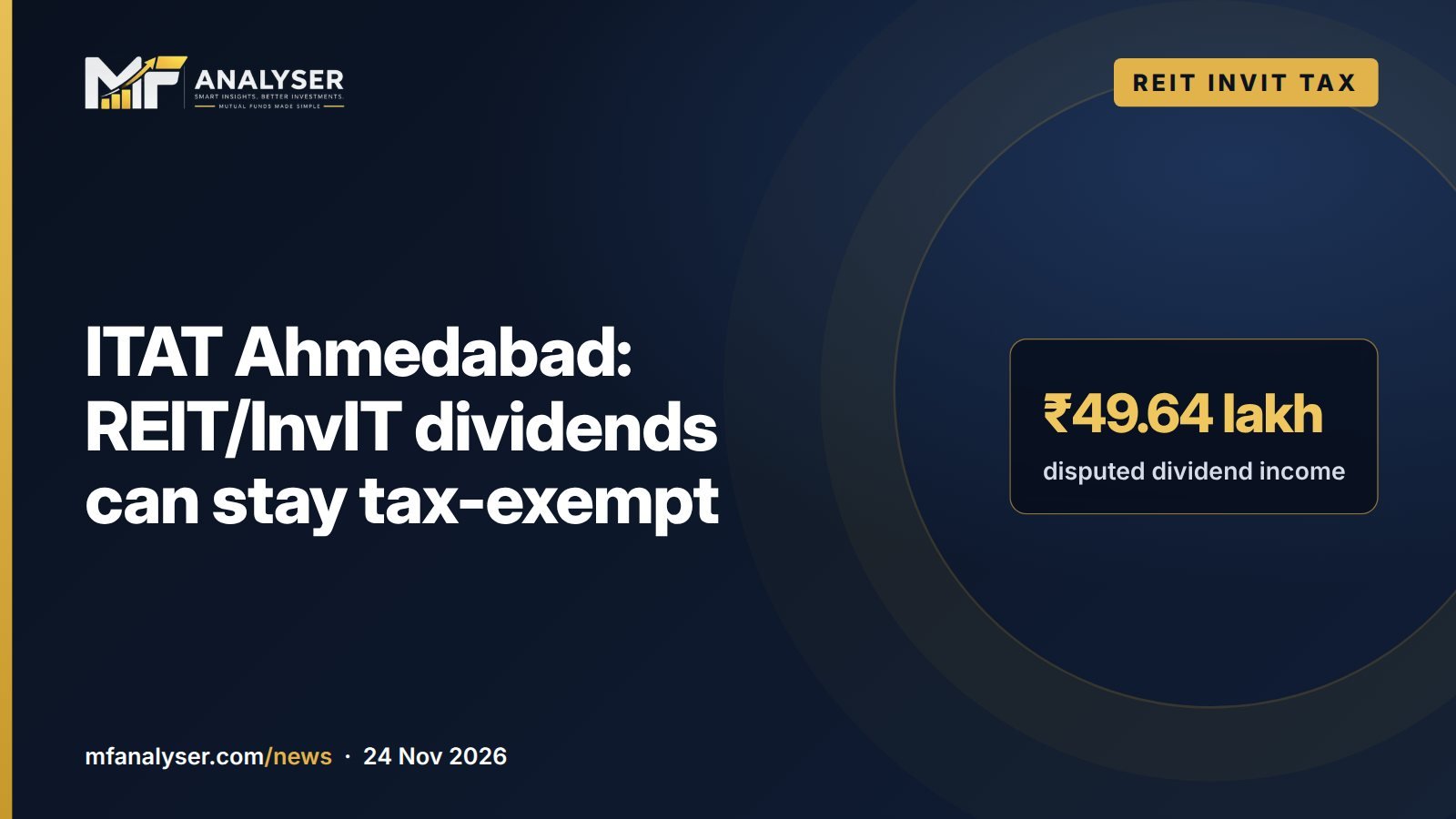
ITAT Ahmedabad backs tax-exempt REIT and InvIT dividends in ₹49.64 lakh dispute
An ITAT Ahmedabad ruling holds that dividend payouts from REITs and InvITs can stay exempt in unitholders' hands even if the underlying SPV did not opt for Section 115BAA, Mint reports. The decision clarifies a common tax-filing dispute for trust investors.
This adds useful clarity on why dividend and interest payouts from business trusts get different tax treatment, and should reduce avoidable disputes for investors who report them correctly.
- ITAT Ahmedabad ruled in favour of a taxpayer over ₹49.64 lakh in REIT and InvIT dividend distributions.
- The exemption can apply when the underlying SPV has not chosen the Section 115BAA concessional regime.
- Form 26AS in the case showed TDS only on the interest component, not on exempt dividends.
A ruling by the Income Tax Appellate Tribunal (ITAT), Ahmedabad, has clarified when dividends paid out by Real Estate Investment Trusts and Infrastructure Investment Trusts can remain exempt in the hands of investors, Mint reported. The case involved ₹49.64 lakh in distributions that tax authorities had sought to add to an investor's taxable income. It matters because business trusts often distribute more than one kind of income, and the tax treatment differs with the nature of the underlying income. (Source: Mint)
What happened
An Ahmedabad-based taxpayer, referred to as Patel, had invested in several SEBI-registered business trusts, including Embassy Office Parks REIT, Mindspace Business Parks REIT and Powergrid Infrastructure Investment Trust. She received ₹49.64 lakh as dividend income and reported it as exempt in her return for Assessment Year 2023-24, in which she declared total income of about ₹16.69 crore. (Source: Mint)
The Assessing Officer held that the exemption under Section 10(23FD) was not available and added the ₹49.64 lakh under 'Income from Other Sources'. After the Commissioner of Income Tax (Appeals) upheld that view, Patel approached the ITAT. The tribunal examined Sections 10(23FD), 10(23FC), 115UA and 194LBA of the Income Tax Act. (Source: Mint)
The dispute turned on whether dividend income from a business trust could be treated as exempt when the underlying Special Purpose Vehicle had not chosen the concessional route under Section 115BAA. In its order dated October 26, 2026, the tribunal ruled in Patel's favour and removed the ₹49.64 lakh addition. (Source: Mint)
Our analysis
The tribunal's reasoning turns on the tax status of the SPV, not just the label of the payout. Because business trusts pass through the character of income, the dividend exemption can survive when the SPV has stayed in the normal tax regime. The tribunal noted that in such cases the dividend remains exempt both in the hands of the business trust and the unitholder.
The tribunal also looked at Section 194LBA(2A), which provides for non-deduction of tax at source on exempt dividend distributions. Patel's Form 26AS supported this distinction: tax had been deducted only on the taxable interest component, not on the dividend distributions received from the REITs and InvITs. (Source: Mint)
This does not create a new exemption, but it reduces ambiguity for investors in listed business trusts. Many investors may not appreciate that a single trust distribution can contain components with different tax rules. The ruling reinforces that the dividend exemption cannot be rejected merely because the SPV has not opted for a lower corporate tax rate.
What this could mean for you
- REIT and InvIT unitholders may be able to treat dividend distributions as exempt if the underlying SPVs have not opted for Section 115BAA, but the exemption depends on the SPV's tax position and the nature of the income. (Source: Mint)
- Investors with high-value trust holdings could see reduced litigation risk if their Form 26AS clearly shows tax deducted only on taxable components such as interest. (Source: Mint)
- Taxpayers who treat all trust distributions alike may be more likely to face disputes, because dividend and interest components are taxed differently.
- Financial advisors and tax planners may need to document the SPV-level tax status behind each REIT or InvIT payout before relying on the exemption.
What to watch next
- Whether tax authorities accept the ITAT's reading in similar cases involving Section 10(23FD) and Section 115BAA. (Source: Mint)
- Disclosures from REITs and InvITs about the tax status of their underlying SPVs and the nature of each distribution.
- Any appeal or clarification by the revenue department on the pass-through treatment of business trust dividends.
Bottom line
This ruling is a useful reference for investors in business trusts because it separates dividend and interest treatment and ties the dividend exemption to the SPV's own tax choice. It does not mean every REIT or InvIT distribution is exempt, but it clarifies one common point of dispute.
Source: Mint — REIT, InvIT dividend income tax-free? ITAT Ahmedabad rules in favour of taxpayer in ₹49.64 lakh tax dispute. This story was written by the MF Analyser News Desk with AI assistance and its figures were checked automatically against the original report. It is for education only and is not investment advice. Mutual fund investments are subject to market risks.