Government vs private hospital: ₹6,631 vs ₹50,508 average stay, and what to check
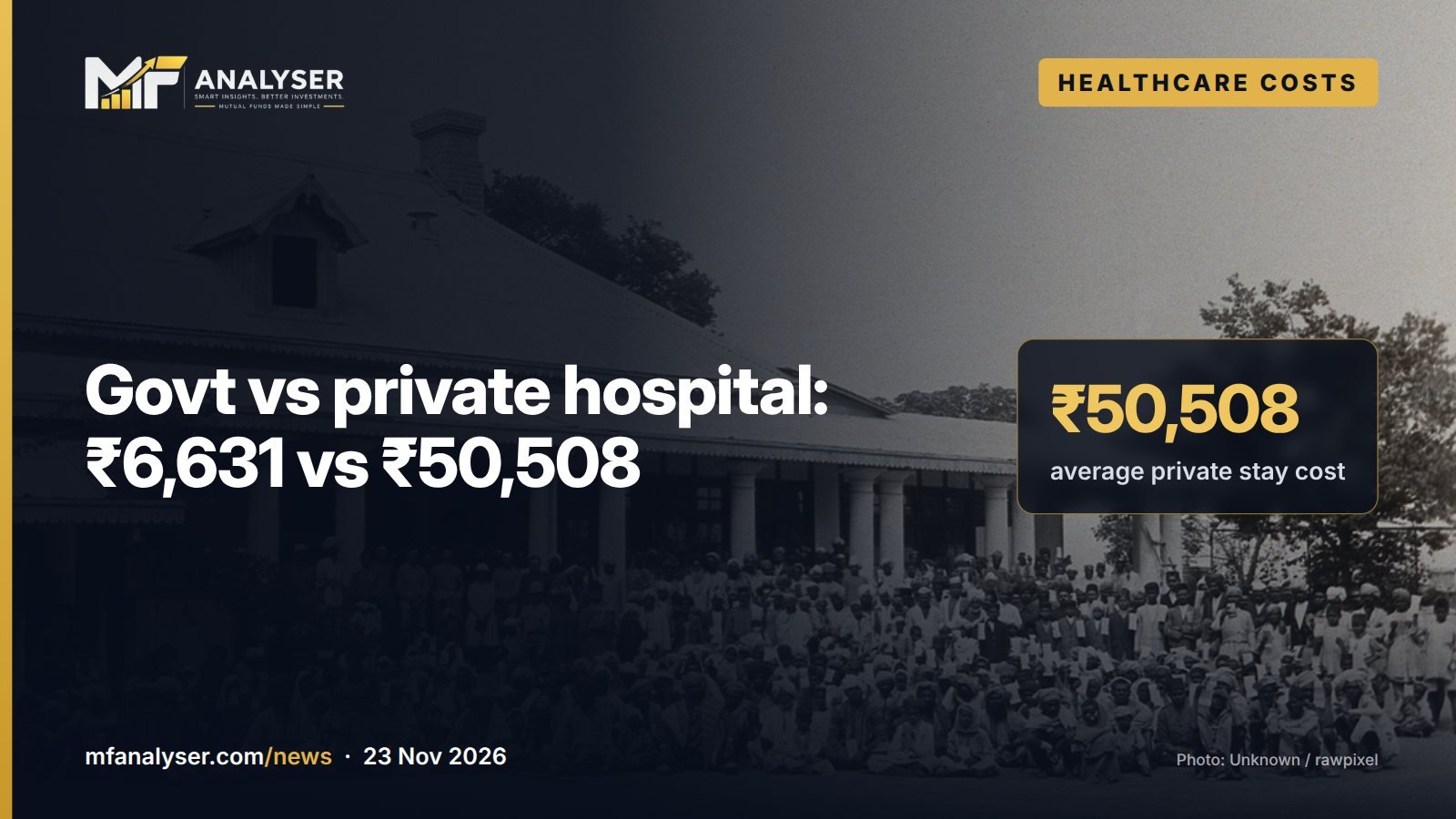
Economic Times data shows an average government hospital stay costs ₹6,631 versus ₹50,508 in private, a 7.6-times gap. We read the decision as hospital-specific: check accreditation, insurance and written estimates.
- Impact
- High
- Topic
- Personal Finance
- Who it affects
- Cost-conscious families · Insured patients · Planned-surgery patients · Emergency patients
- Published
- 23 Nov 2026, 11:17 am IST
The cost difference is stark but quality is facility-specific, so the practical task is comparing written estimates, insurance acceptance and accreditation before admission.
- Average government hospital stay costs ₹6,631; private costs ₹50,508, about 7.6 times more.
- ICU stays are reported at ₹1,500 per day in government versus ₹30,000 in private hospitals.
- Both hospital types employ licensed staff, but quality varies; accreditation and insurance acceptance matter.
When a medical need arises, the choice between a government and a private hospital can alter a family’s bill by lakhs of rupees. Economic Times has laid out the cost difference, wait times, and insurance angles using NSO survey and parliamentary data, and our read is that the decision is less about public versus private and more about the specific hospital, your coverage, and the urgency of care.
What happened
According to the report, an average general hospital stay costs about ₹6,631 in a government facility and about ₹50,508 in a private one, roughly 7.6 times higher. For childbirth, the average is about ₹2,299 in a government hospital against ₹30,000 to ₹40,000 in a private one, up to 15 times more. Even outpatient treatment averages ₹289 per treatment cycle in government hospitals and ₹1,447 in private ones. (Source: Economic Times)
The gap widens for serious care. The report pegs an ICU day at around ₹1,500 in a government hospital and ₹30,000 in a private one, and open-heart surgery at about ₹95,000 against ₹2.8 lakh or more. It adds that real private bills often include room rent, doctor fees, consumables, diagnostics and medicines on top, and recommends asking for a written estimate before admission. (Source: Economic Times)
Our analysis
The reason for the gap is straightforward: government hospitals are publicly funded and heavily subsidised, so consultations, diagnostics and generic medicines are cheap or free, while private hospitals charge market rates for doctors, rooms, tests and consumables. In exchange, private facilities usually offer shorter queues, faster reports, newer equipment and more specialists, but they also carry surprise charges and are concentrated in cities.
What this signals is that cost is not a reliable proxy for quality. Both types employ licensed doctors and nurses, follow infection control rules, maintain records and offer emergency care, but performance varies by location and management. Some government hospitals are among the best in the country, and some private ones are poor, so our read is that accreditation such as NABH, doctor experience and the specific hospital’s reputation matter more than the ownership label.
Insurance and schemes change the practical burden. Many private hospitals offer cashless treatment if they are on the insurer’s network, but claims depend on policy terms, waiting periods and exclusions. Under Ayushman Bharat PM-JAY, eligible families can get treatment at empanelled government and private hospitals without paying at the counter. A good health insurance plan can narrow the out-of-pocket cost gap, but the report cautions to confirm cashless approval in writing before admission.
What this could mean for you
- Cost-conscious families may find planned treatment and free or low-cost medicines more affordable in government hospitals, but they could face heavy patient load, shared wards and slower discharge.
- Insured patients with a strong network policy may find private care more accessible because of shorter waits and private rooms, though delays and exclusions can still leave them paying part of the bill.
- Planned-surgery patients could see a very large price difference: the same open-heart procedure is reported at about ₹95,000 in a government hospital versus ₹2.8 lakh or more in a private one, so waiting longer in a government queue may save a large sum if the condition allows it. (Source: Economic Times)
- Emergency cases may not have the luxury of comparison; the report’s general guidance is to go to the nearest hospital that can treat without delay, because speed can matter more than cost in a crisis.
What to watch next
- Ask for a written estimate before admission and check what is excluded, since real private bills often add room rent, doctor fees, consumables, diagnostics and medicines.
- Confirm whether the hospital is in your insurer’s network or empanelled under Ayushman Bharat PM-JAY, and get cashless approval in writing.
- Compare total estimated cost, wait time, insurance/scheme acceptance, accreditation and treating doctor before deciding.
Bottom line
The cost gap between government and private hospitals is large and well documented, but the right choice depends on urgency, coverage and the specific facility. Our overall read is that comparing written estimates, insurance acceptance and accreditation before admission reduces the chance of a financial shock later.
Quick answers
What happened?
Economic Times data shows an average government hospital stay costs ₹6,631 versus ₹50,508 in private, a 7.6-times gap. We read the decision as hospital-specific: check accreditation, insurance and written estimates.
What does this mean for investors?
The cost difference is stark but quality is facility-specific, so the practical task is comparing written estimates, insurance acceptance and accreditation before admission.
Who is affected?
Cost-conscious families, Insured patients, Planned-surgery patients, Emergency patients.
What are the key facts?
Average government hospital stay costs ₹6,631; private costs ₹50,508, about 7.6 times more. ICU stays are reported at ₹1,500 per day in government versus ₹30,000 in private hospitals. Both hospital types employ licensed staff, but quality varies; accreditation and insurance acceptance matter.
When was this published?
MF Analyser News published this on 23 November 2026 IST.
Primary source: Economic Times · For education only, not investment advice. Mutual fund investments are subject to market risks.