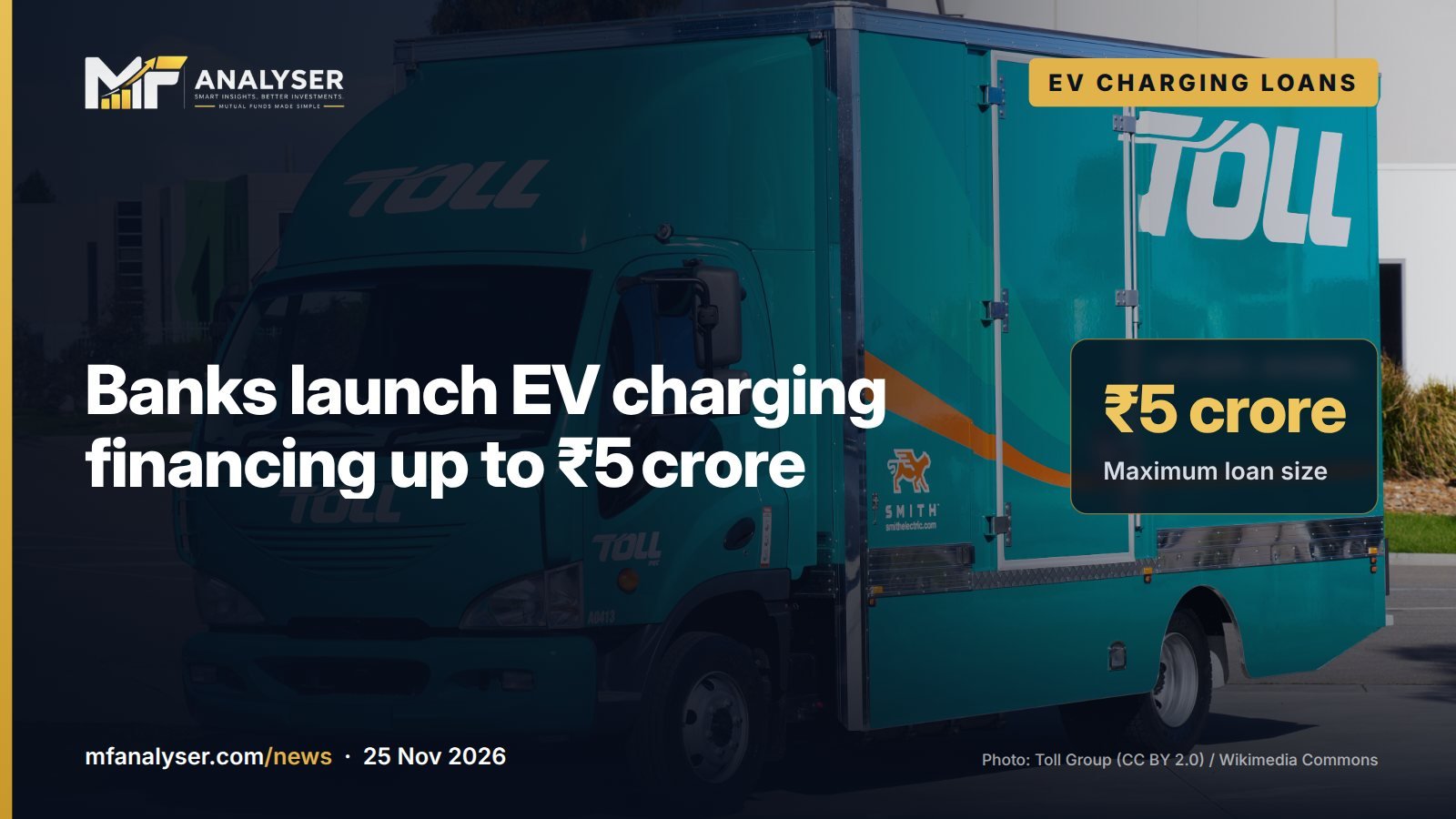
Public sector banks roll out EV charging loan schemes up to ₹5 crore
CNBC-TV18 reports that several public sector banks have introduced dedicated loan products for EV charging and battery‑swapping infrastructure, targeting MSMEs and larger commercial players. We examine how the loan sizes, interest bands and repayment terms could shape the rollout of charging networks in India.
- Impact
- Medium
- Topic
- Personal Finance
- Who it affects
- MSME owners · EV charging operators · Renewable energy investors · Commercial real estate developers
- Published
- 25 Nov 2026, 8:45 am IST
The new financing options expand credit access for EV charging projects, which should support a steadier build‑out of infrastructure while keeping borrowing costs modest.
- Bank of Baroda’s loan interest ranges from 8.15% to 9.60%
- All schemes require a minimum borrower contribution of 25% where specified
- Loan tenures extend up to 120 months with moratorium periods up to 12 months
CNBC-TV18 notes that a group of public sector banks – Bank of Baroda, State Bank of India, Indian Bank and Central Bank of India – have launched specialised loan schemes to fund electric‑vehicle charging stations and battery‑swapping facilities. The products are aimed at businesses ranging from startups to fuel stations and residential societies, with loan sizes starting above ₹10 lakh and reaching up to ₹5 crore or ₹10 crore depending on the bank. (Source: CNBC-TV18)
What happened
Bank of Baroda’s bob Green PLUG, launched on November 19, offers term or demand loans from above ₹10 lakh to ₹5 crore, with interest linked to the Baroda Repo Linked Lending Rate and ranging from 8.15% to 9.60%. Repayment can extend to 120 months and includes a moratorium of up to 12 months. SBI’s EV Mitra scheme also provides loans above ₹10 lakh to ₹5 crore, requires a 25% borrower contribution, and allows up to eight years of repayment with a nine‑month moratorium. Indian Bank’s IND Green Charge covers loans from above ₹10 lakh to ₹10 crore, sets interest between 9% and 9.25%, and offers up to 96 months of tenure with a six‑month moratorium. Central Bank of India’s Cent EV Connect extends loans from ₹11 lakh to ₹10 crore, also mandates a 25% contribution, and ties equipment certification to ARAI standards. (Source: CNBC-TV18)
Our analysis
By anchoring rates to their respective repo‑linked benchmarks, the banks keep the cost of capital close to prevailing market rates, which limits a sudden spike in financing costs for new charging projects. The relatively wide loan ceiling – up to ₹5 crore for most lenders and ₹10 crore for Indian Bank and Central Bank – signals confidence that larger, multi‑site deployments are viable, especially for entities that can marshal a 25% equity contribution. (Source: CNBC-TV18)
The inclusion of moratorium periods, ranging from six to twelve months, eases early cash‑flow pressure, allowing operators to focus on site acquisition and equipment installation before revenue streams mature. Covering renewable‑energy‑integrated stations, such as rooftop solar‑powered chargers, aligns the financing with broader sustainability goals and may attract borrowers seeking green credentials.
What this could mean for you
- MSME owners could tap the schemes to add charging points at fuel stations or logistics hubs, with modest interest rates and a built‑in grace period to manage initial outlays.
- EV charging operators may find the higher loan caps useful for scaling from a single site to a network, especially where a 25% equity stake is feasible. (Source: CNBC-TV18)
- Renewable energy investors might see an added incentive to pair solar installations with charging infrastructure, given the explicit coverage of renewable‑integrated stations.
- Commercial real estate developers can consider captive charging solutions for office parks or residential societies, leveraging the up‑to‑120‑month tenure to spread repayments over the asset’s useful life. (Source: CNBC-TV18)
What to watch next
- Adoption rates of the schemes across different states, especially in regions with higher EV penetration.
- Any revision of the Baroda Repo Linked Lending Rate, which would directly affect the interest band for Baroda’s product.
- Regulatory updates on ARAI certification standards that could influence equipment eligibility.
Bottom line
The coordinated rollout of loan products by major public banks lowers financing barriers for EV charging infrastructure, potentially accelerating network growth while keeping borrowing costs aligned with market rates.
Quick answers
What happened?
CNBC-TV18 reports that several public sector banks have introduced dedicated loan products for EV charging and battery‑swapping infrastructure, targeting MSMEs and larger commercial players. We examine how the loan sizes, interest bands and repayment terms could shape the rollout of charging networks in India.
What does this mean for investors?
The new financing options expand credit access for EV charging projects, which should support a steadier build‑out of infrastructure while keeping borrowing costs modest.
Who is affected?
MSME owners, EV charging operators, Renewable energy investors, Commercial real estate developers.
What are the key facts?
Bank of Baroda’s loan interest ranges from 8.15% to 9.60%. All schemes require a minimum borrower contribution of 25% where specified. Loan tenures extend up to 120 months with moratorium periods up to 12 months.
When was this published?
MF Analyser News published this on 25 November 2026 IST.
Primary source: CNBC-TV18 · For education only, not investment advice. Mutual fund investments are subject to market risks.