8th Pay Commission’s proposed fitment factors could lift basic pay for central employees
The 8th Pay Commission is reviewing union demands for fitment factors between 2.92 and 4.00. We examine how a higher multiplier could raise basic salaries, affect disposable income and shape savings behaviour for Indian households.
- Impact
- Medium
- Topic
- Personal Finance
- Who it affects
- Central government employees · FD savers · SIP investors · Retirees
- Published
- 26 Nov 2026, 6:46 am IST
Higher fitment factors would likely raise disposable income for central government employees, with downstream effects on consumption and savings patterns.
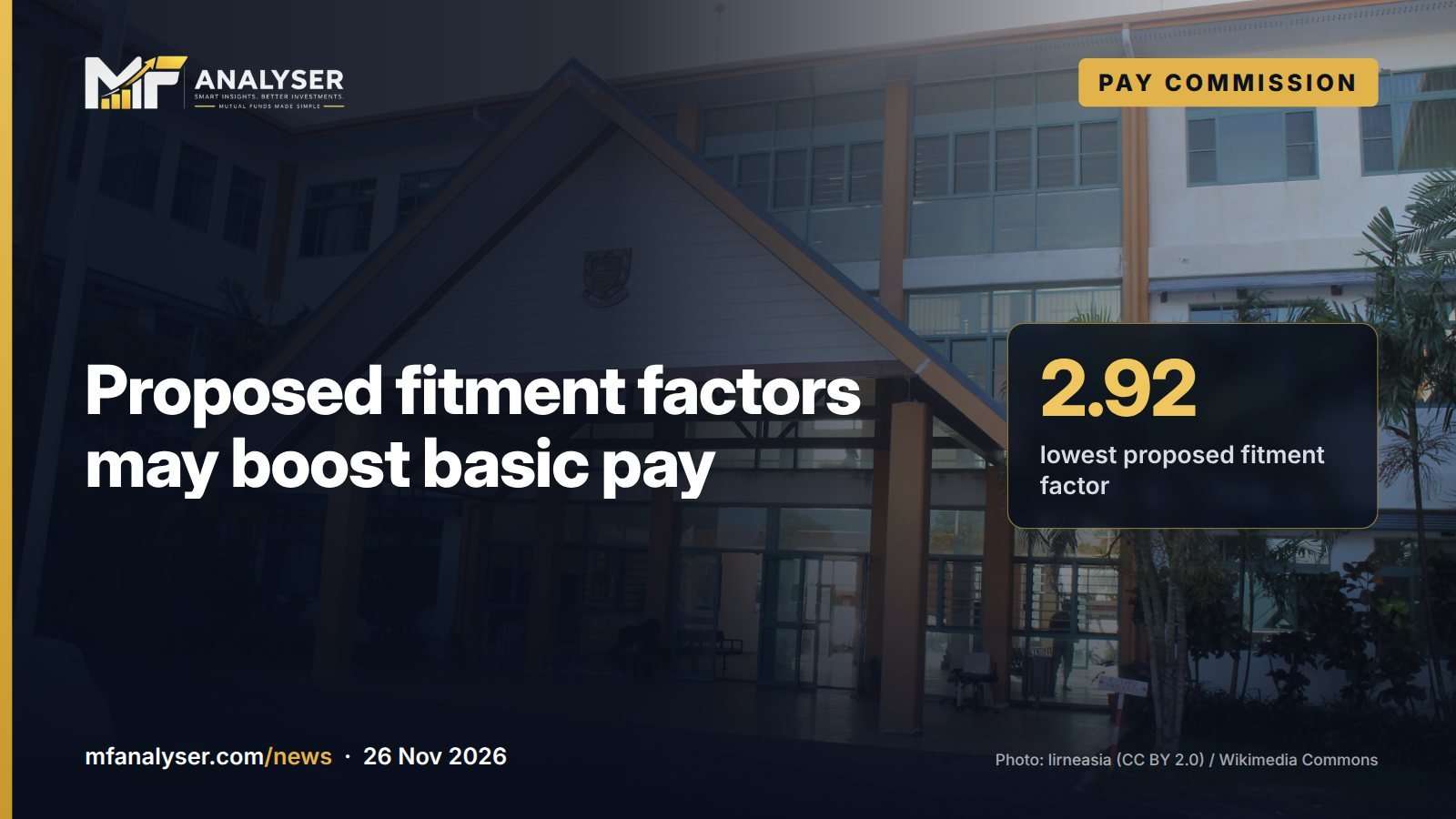
- Fitment factor proposals range from 2.92 to 4.00
- Previous commissions used multipliers of 1.86 and 2.57
- The commission’s report is due by May‑June 2027
The 8th Pay Commission is weighing union proposals for fitment factors ranging from 2.92 to 4.00, a step that could materially raise basic pay for serving and retired central government employees. This matters because basic pay forms the base for a host of allowances and ultimately determines household cash flow. (Source: source)
What happened
The commission, constituted on 3 November 2025, held two meetings in Bengaluru and Mumbai on 8 October and 23 October. It is currently examining proposals to revise salaries, pensions, fitment factor multiplier, allowances and related benefits. Earlier commissions used fitment factors of 1.86 (6th) and 2.57 (7th). Prominent unions such as the Indian Railways Technical Supervisors' Association, Ministerial Staff Association, National Council‑JCM Staff Side, Bharat Pensioners Samaj and Bharatiya Pratiraksha Mazdoor Sangh have asked for multipliers of 2.92, 3.61, 3.833 and 4.00, with some demands even higher for certain pay levels. The final multiplier will be announced after the three‑member panel, headed by Justice Ranjana Prakash Desai, tables its report, tentatively due in May‑June 2027. (Source: source)
Our analysis
Unions are pushing for a substantially larger fitment factor because basic pay is the reference point for dearness allowance, house rent allowance and pension calculations. A higher multiplier therefore amplifies not only the take‑home salary but also downstream benefits that are indexed to basic pay. For example, an employee with a basic of ₹ 18,000 would see a revised basic of ₹ 63,000 if a factor of 3.5 were applied, illustrating the scale of change that a factor in the 3‑4 range could generate. (Source: source)
This upward pressure on salaries could boost household consumption, especially for middle‑income government employees who form a sizable segment of the retail market. At the same time, larger basic pay expands the tax base, potentially offsetting some fiscal cost through higher income tax receipts. However, the government will need to balance these gains against the broader fiscal implications of higher payroll outlays.
From a savings perspective, higher disposable income may encourage greater allocation to fixed‑deposit (FD) products and systematic investment plans (SIPs), but the net effect will depend on individual risk appetite and the prevailing interest‑rate environment. Retirees receiving pensions linked to basic pay could also see a modest uplift, which may affect their reliance on post‑retirement investment vehicles.
What this could mean for you
- SIP investors could see a larger pool of fresh contributions if employees channel higher take‑home pay into regular equity or debt SIPs, assuming stable market expectations.
- FD savers may benefit from increased deposits as higher cash flow enables longer‑term fixed‑deposit placements, particularly if interest rates remain attractive.
- Retirees whose pensions are indexed to basic pay might experience a modest rise in pension receipts, potentially reducing the need for supplemental income sources.
- First‑time home buyers from the central employee segment could find it easier to meet down‑payment requirements, given the uplift in regular earnings.
What to watch next
- Announcement of the final fitment factor after the commission’s report, expected by May‑June 2027. (Source: source)
- Any accompanying changes to dearness allowance or other allowances that are tied to basic pay.
- Government fiscal statements that address the budgetary impact of higher payroll outlays.
Bottom line
In our view, the proposed fitment factors signal a potential rise in basic salaries for central government employees, which could translate into higher disposable income. The broader effect on savings and consumption will hinge on how individuals allocate the additional cash flow and on the fiscal response of the government.
Quick answers
What happened?
The 8th Pay Commission is reviewing union demands for fitment factors between 2.92 and 4.00. We examine how a higher multiplier could raise basic salaries, affect disposable income and shape savings behaviour for Indian households.
What does this mean for investors?
Higher fitment factors would likely raise disposable income for central government employees, with downstream effects on consumption and savings patterns.
Who is affected?
Central government employees, FD savers, SIP investors, Retirees.
What are the key facts?
Fitment factor proposals range from 2.92 to 4.00. Previous commissions used multipliers of 1.86 and 2.57. The commission’s report is due by May‑June 2027.
When was this published?
MF Analyser News published this on 26 November 2026 IST.
Primary source: Mint · For education only, not investment advice. Mutual fund investments are subject to market risks.