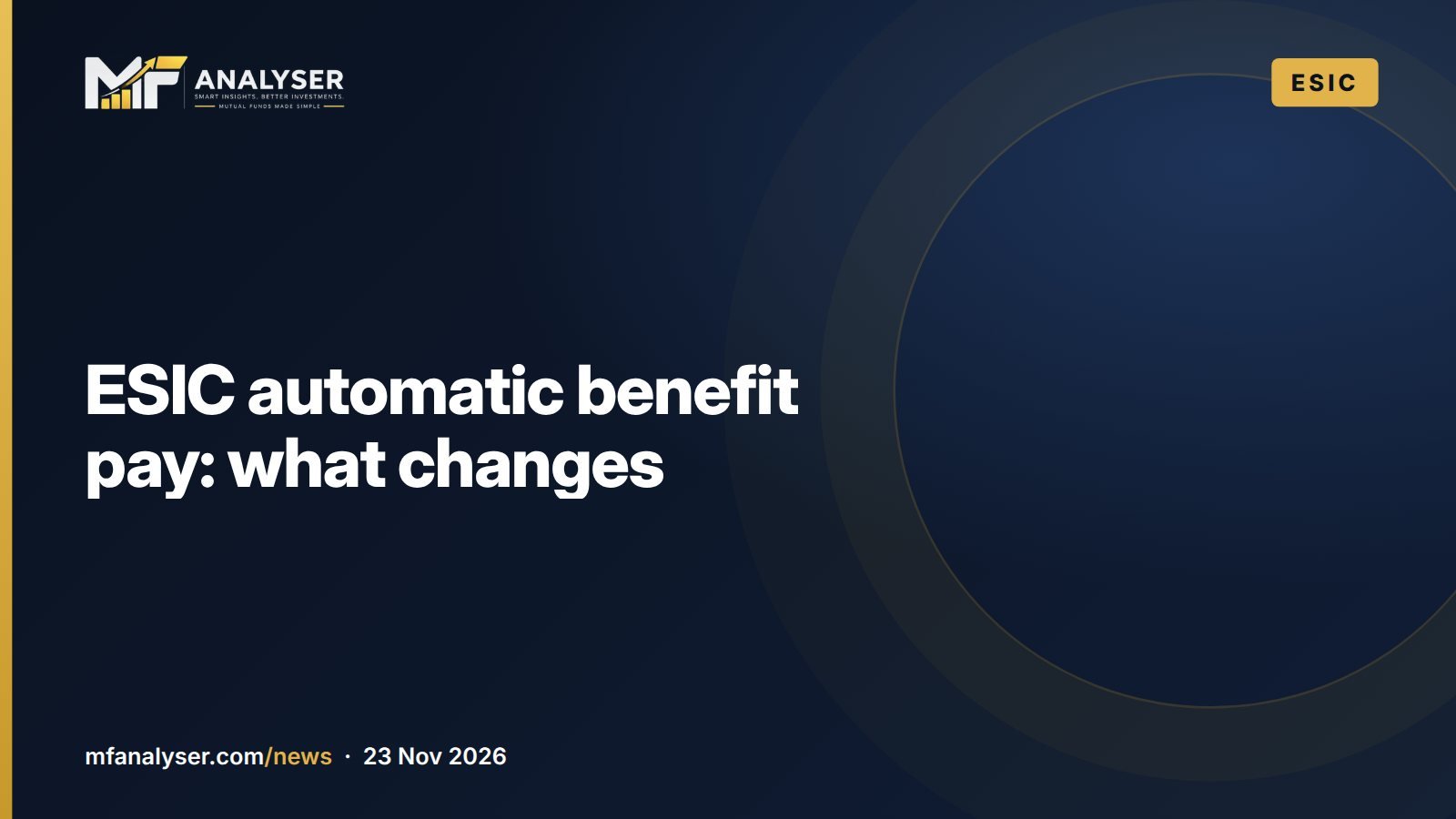
ESIC automatic sickness and maternity pay via DBT: what changes for workers
CNBC-TV18 reports ESIC has issued rules to auto-pay sickness and maternity benefits through DBT once conditions are met, without a separate claim. We examine the mechanics, safeguards and rollout timing.
- Impact
- Medium
- Topic
- Personal Finance
- Who it affects
- ESIC-insured workers · Maternity and sickness benefit claimants · Employers and payroll teams · Dependants of insured workers
- Published
- 23 Nov 2026, 8:50 am IST
This is a process-level improvement that reduces paperwork but depends on implementation and Aadhaar-linked records, so the practical benefit is conditional.
- ESIC notified the Employees' State Insurance (General) Regulations, 2026, replacing the 1950 rules, under the Code on Social Security, 2020.
- Sickness and maternity benefits can be paid automatically through DBT once three conditions are met, without a separate claim.
- A separate implementation order from the ESIC Director General is needed before the automatic facility becomes operational.
CNBC-TV18 has reported that the Employees' State Insurance Corporation has issued fresh rules allowing automatic payment of sickness and maternity benefits to eligible insured workers through direct benefit transfer, without needing to file a separate claim, once certain conditions are met. This matters because it moves the claims process from a worker-initiated step to an automatic backend check, and it reduces the chance that an employer's late return holds up a payout. The benefit itself is not new, but the processing path is being redesigned. (Source: CNBC-TV18)
What happened
The new framework sits under the Employees' State Insurance (General) Regulations, 2026, which replace the 1950 regulations and are framed under the Code on Social Security, 2020. The notification is dated November 20 and appeared in the Gazette of India the next day. (Source: CNBC-TV18)
Under Regulation 29A, sickness and maternity benefits can be paid without a claim from the insured person if three conditions are fulfilled. Once fulfilled, the claim is treated as having been raised, and the payment is sent to the beneficiary's bank account through DBT. Regulation 29C keeps the option to file a claim electronically or by the prescribed form, and the regular process remains available where automatic processing conditions are not met, such as a medical certificate issued outside ESIC's information system. (Source: CNBC-TV18)
In employment-injury cases, Regulation 29B treats the employer's report as the claim for temporary disablement, permanent disablement and dependants' benefits. Temporary disablement payments go through DBT when the Regulation 29A conditions are met. Permanent disablement payments require assessment by a competent medical or judicial authority, and dependants' benefits involve nomination, identity verification and Aadhaar-linked bank details. (Source: CNBC-TV18)
The rules also say benefits should not be withheld only because an employer has not filed the required return by the due date; the ESIC office must call for employer verification. The automatic facility will begin only from a date the ESIC Director General specifies later.
Our analysis
Our read is that this follows the direction of moving social-security payments to Aadhaar-linked DBT and reducing dependence on manual claim forms. It signals an attempt to fix a common failure point: an eligible worker may lose time or money because a certificate, claim form or employer return is incomplete, even when the underlying entitlement is clear. By treating the claim as raised automatically, ESIC is shifting the compliance burden toward data quality and system checks rather than submission by the claimant.
For an automatic path to work, the critical dependency is record hygiene. Workers whose ESIC insurance number is linked to Aadhaar, whose bank account is Aadhaar-enabled and whose medical certificate is generated inside ESIC's information system are the ones likely to benefit first. Anyone outside those conditions may still need the regular claim route, which remains protected under Regulation 29C. So the change is more about faster processing for clean records than a universal guarantee of instant payment. (Source: CNBC-TV18)
Employers also gain some clarity. The provision that an employer's delay should not by itself block a benefit is important, though it is procedural; it does not remove the employer's reporting duty. The larger signal is that the Code on Social Security is gradually being operationalised through sub-regulations, and we would expect more such process rationalisation in other social-security benefits.
What this could mean for you
- ESIC-insured workers could see shorter waiting times for sickness and maternity payouts once the system goes live, provided their ESIC number, Aadhaar and bank account are linked and certificates are in the ESIC system.
- Maternity and sickness benefit claimants may not need to file a separate claim in clean cases, but the regular filing option remains if any automatic condition is missing.
- Workers with incomplete records are unlikely to lose their entitlement; they can still use the existing claim process, especially if a medical certificate comes from outside ESIC's information system.
- Employers and payroll teams may face new verification requests from ESIC when a return is late, but the rules intend to stop employee payouts from being held up solely by that delay.
What to watch next
- The implementation date to be announced by the ESIC Director General through a separate order.
- Clarity on the three conditions for automatic processing and how ESIC verifies Aadhaar and bank account linkage.
- Operational guidance on employment-injury claims, especially how employer reports flow into temporary and permanent disablement benefits.
Bottom line
The new ESIC regulations are a process improvement, not a new benefit: they aim to cut claim friction for sickness and maternity payments and protect workers from employer-side delays. The actual impact for Indian households will depend on how quickly the operational order is issued and how well worker records are Aadhaar-seeded and digitised.
Quick answers
What happened?
CNBC-TV18 reports ESIC has issued rules to auto-pay sickness and maternity benefits through DBT once conditions are met, without a separate claim. We examine the mechanics, safeguards and rollout timing.
What does this mean for investors?
This is a process-level improvement that reduces paperwork but depends on implementation and Aadhaar-linked records, so the practical benefit is conditional.
Who is affected?
ESIC-insured workers, Maternity and sickness benefit claimants, Employers and payroll teams, Dependants of insured workers.
What are the key facts?
ESIC notified the Employees' State Insurance (General) Regulations, 2026, replacing the 1950 rules, under the Code on Social Security, 2020. Sickness and maternity benefits can be paid automatically through DBT once three conditions are met, without a separate claim. A separate implementation order from the ESIC Director General is needed before the automatic facility becomes operational.
When was this published?
MF Analyser News published this on 23 November 2026 IST.
Primary source: CNBC-TV18 · For education only, not investment advice. Mutual fund investments are subject to market risks.